Examine / Tonometry and pressure
Tonometry and intraocular pressure
A number that matters, and what it does not tell you.
Intraocular pressure is the balance between aqueous made and aqueous drained, measured by flattening a known area of the cornea. It is the main modifiable risk factor for glaucoma and the emergency number in angle closure. It does not define glaucoma on its own.
Goldmann applanation
The reference method. A drop of anaesthetic with fluorescein, the cobalt blue filter, and a small plastic prism pressed gently against the cornea until it flattens a circle 3.06 mm across, the diameter at which the tear film's surface tension and the cornea's rigidity cancel out (the Imbert-Fick principle). The examiner sees two green semicircles (mires) and turns the dial until their inner edges just touch; the dial reads the pressure in millimetres of mercury. A thick cornea reads high and a thin one low, which is why pachymetry is measured once.
| Reading | Means |
|---|---|
| 10 to 21 mmHg | The statistical normal range, with a diurnal swing of a few millimetres, highest in the morning |
| 22 to 30 mmHg with a normal nerve | Ocular hypertension: a risk, followed, sometimes treated |
| Over 40 mmHg with pain and a cloudy cornea | Acute angle closure until proven otherwise |
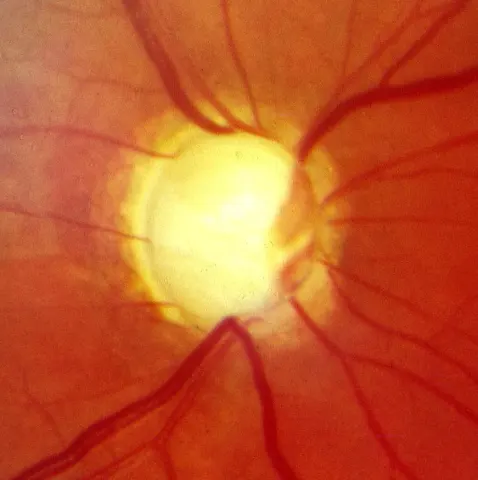
| A normal reading with a glaucomatous disc and field | Normal-tension glaucoma: the nerve decides, not the number |
Other tonometers
Rebound tonometry (iCare) bounces a tiny probe off the cornea and needs no anaesthetic, which makes it the instrument for children and the ward. Non-contact (air-puff) tonometry flattens the cornea with a jet of air, is quick for screening, and reads higher and more variably. Tono-Pen is portable and works through a contact lens or a scarred cornea. Palpation, comparing the two eyes with the fingertips through closed lids, tells you only that an eye is stone hard, which in angle closure is enough.
What affects the reading
Corneal thickness (thick reads high), a tight collar or breath-holding (both raise it), a squeezing patient, pressure from the examiner's fingers on the globe, and the time of day. Never measure it on a suspected open globe.
Glaucoma: aqueous and pressure Gonioscopy: the angle it drains through
Go and look
Where this topic leads