Adnexa · 23 of 24
What is the upper tarsal plate?
The tarsal plate is the dense fibrous skeleton of the eyelid, a curved plate of tough connective tissue about a millimetre thick that gives the lid its shape and its firm edge. The upper tarsus is about ten millimetres tall, the lower about four. Set inside it in a row are the meibomian glands, which open along the lid margin behind the lashes and supply the oil that stops tears evaporating.
- Height
- About 10 mm in the upper lid, 4 mm in the lower
- Contains
- About 25 to 30 meibomian glands in the upper lid, running vertically
- Attached to
- The levator aponeurosis and Müller's muscle above; the canthal tendons at each end
- Lined by
- Conjunctiva, tightly bound to its back surface
The layers of the lid
From front to back the upper lid is skin, orbicularis oculi, the orbital septum and fat, the levator aponeurosis, the tarsal plate with Müller's muscle attaching to its upper edge, and the conjunctiva. The lid margin has the lashes in front and the meibomian gland openings behind, with the grey line between them marking the plane the lid splits along. The levator, supplied by the third nerve, lifts the lid; Müller's muscle, sympathetic, adds two millimetres, which is why the lid droops slightly in Horner syndrome and fully in a third nerve palsy.
Because the tarsus is stiff and the conjunctiva is bound to it, the upper lid can be everted over its upper edge with a cotton bud to look for a foreign body on its inner surface, the tarsal conjunctiva, where the follicles of trachoma and the papillae of allergy are seen.
What goes wrong
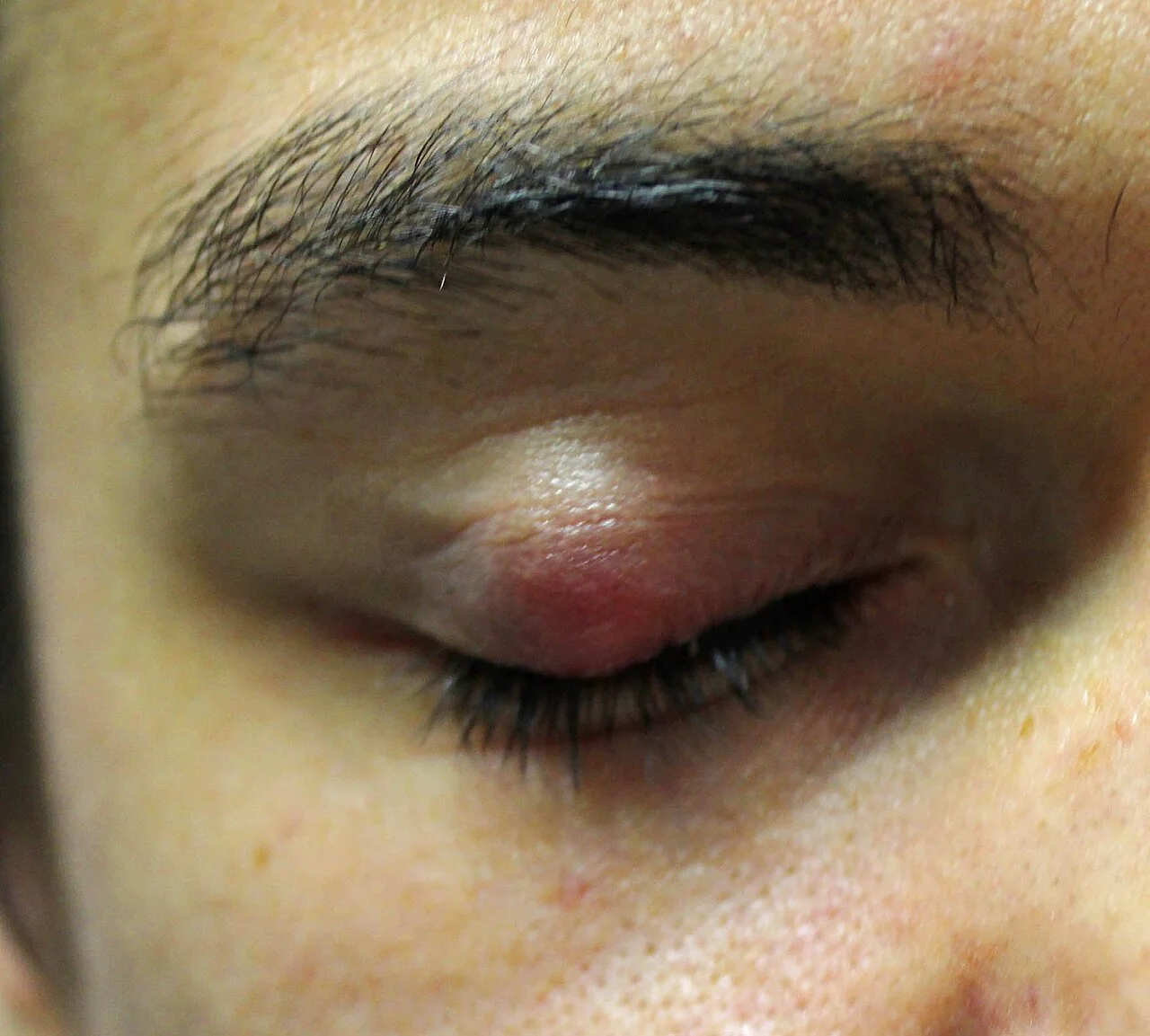
A chalazion is a blocked meibomian gland inside the tarsus: a firm painless lump in the lid that points inwards, resolving with warm compresses over weeks or drained through the conjunctiva. A stye, external hordeolum, is an infected lash follicle at the margin, and points outwards. Blepharitis inflames the margin and the gland openings and is the commonest cause of dry, gritty, red-rimmed eyes. A lid that does not lift, ptosis, is a levator that has stretched with age or a nerve or muscle that has failed; a lid that lifts too far, retraction, is thyroid eye disease. Basal cell carcinoma is the commonest lid tumour, a pearly nodule with a rolled edge that loses its lashes, usually on the lower lid.
Examine it
A chalazion is a blocked meibomian gland inside it; the lid everts over its upper edge.
Ask OphthoSpace about the upper tarsal plate
AI responses are for education and may contain errors. OphthoSpace is not for primary clinical diagnosis.