Examine / Amsler grid
The Amsler grid
A ten-centimetre square that catches the macula changing before the chart does.
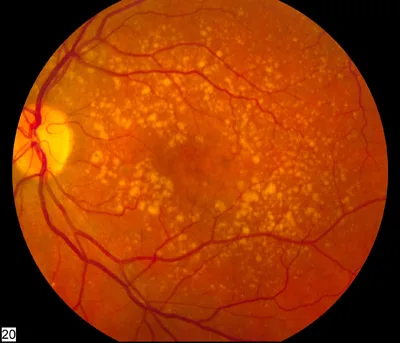
The Amsler grid tests the central ten degrees of vision, one eye at a time, for the distortion, blur and missing patches of macular disease. It takes a minute in clinic, and it is the test patients with age-related macular degeneration take home, because a new wavy line is the earliest sign that a dry macula has turned wet.
Reading is slower than it was, at 74Open in the atlas
How it is done
The grid is a square of twenty by twenty small squares, about ten centimetres across, with a dot at the centre. The patient holds it at reading distance, about thirty centimetres, wearing their reading glasses, in good light, with one eye covered. They fix on the central dot and keep looking at it while they answer: can you see the dot; can you see all four corners; are any of the lines wavy, bent, blurred or missing; is there any grey or blank patch. Then the other eye.
Each eye is tested alone, because with both eyes open the good eye fills in what the bad eye cannot see. Ask the patient to draw what they see on the grid; the drawing goes in the notes and is the baseline for next time.
- Cover the eye, not the glasses, and do not let them scan around the grid; the test is of what is seen while fixing on the dot.
- A patient with a central scotoma may not be able to see the dot at all; ask them to look where it should be.
What the answers mean
The grid does not name the disease; it says where the macula has changed and in what way, and the OCT says why.
| Report | Term | Think of |
|---|---|---|
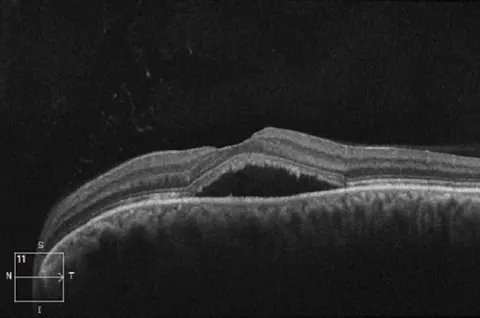
| Lines look wavy or bent | Metamorphopsia | Fluid or traction at the macula: wet age-related macular degeneration, central serous chorioretinopathy, an epiretinal membrane |
| A grey or missing patch in the centre | Central scotoma | Geographic atrophy, a macular hole, a disciform scar; an optic neuropathy when colour is lost too |
| Lines look smaller or larger than they should | Micropsia or macropsia | Oedema spreading or crowding the photoreceptors, as in central serous chorioretinopathy |
| Blur without distortion | Reduced acuity | Refractive error, cataract or early macular oedema; the pinhole and the slit lamp decide |
| A missing half or quadrant with a straight vertical edge | A field defect, not a macular one | The visual pathway; go to the fields |
At home, and what a change means
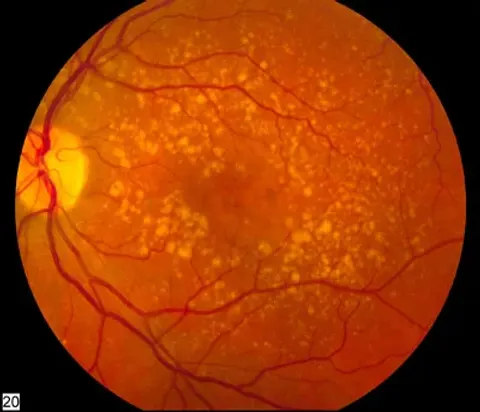
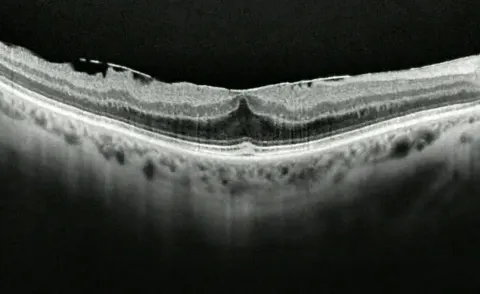
Urgent · same dayPatients with drusen or intermediate age-related macular degeneration keep the grid on the fridge and test each eye once a week. A new wavy line, a new blank patch or a sudden drop in reading vision means the dry macula may have developed a neovascular membrane, and it needs an OCT and a retina appointment within days, not weeks, because anti-VEGF injections work best before the membrane scars.
The grid is a screen, not a guarantee: many patients do not notice early change, and a normal grid in a symptomatic patient does not close the question. The appointment does.
Go and look
Where this topic leads